


The most powerful tools for us are teeth. They help us in eating, drinking and imagine waking up with a toothache or wincing at the first sip of your morning coffee. The first thing that crosses your mind: How bad is this, and what’s it going to cost me? Cavities and rot get worse over time. They can damage the root canal systems and soft tissue inside our teeth if we don’t fix them, which can cause infections, swelling, and damaged tissue.
Most tooth problems can be fixed with one of two very common but very different procedures: a filling or a root canal. While both procedures are designed to kill the discomfort and restore a damaged tooth, they address entirely different levels of decay.
What Is Root Canal?
A root canal, also known as (endodontic therapy) is a dental treatment that can save a tooth that is highly decayed or infected. It involves removing the infected or inflamed pulp from inside the tooth and then cleaning, sealing and disinfecting the root canals to keep them from getting infected again.
What Is a Filling?
A tooth filling is a therapeutic dentistry treatment in which a dentist replaces weak or decayed tooth structure with a strong material. Its main purpose is to fill holes, treat small cracks, and keep the tooth from decaying further.
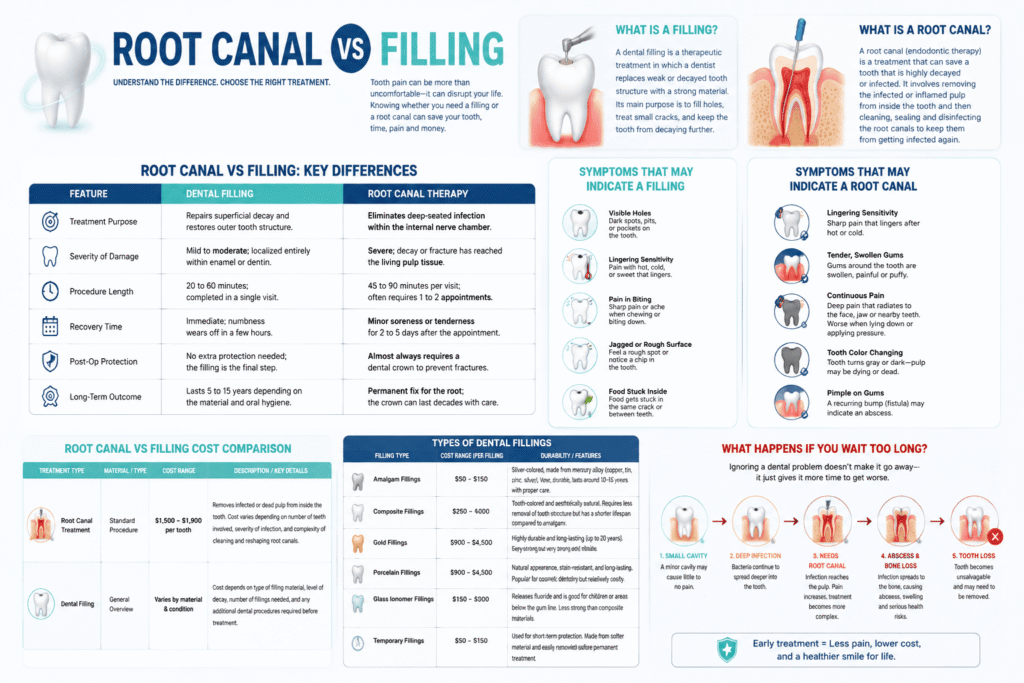
Root Canal vs Filling: Key Differences
To help you understand how these treatments compare, it helps to look at them side by side across several practical categories:
| Feature | Dental Filling | Root Canal Therapy |
| Treatment Purpose | Repairs superficial decay and restores outer tooth structure. | Eliminates deep-seated infection within the internal nerve chamber. |
| Severity of Damage | Mild to moderate; localized entirely within enamel or dentin. | Severe; decay or fracture has reached the living pulp tissue. |
| Procedure Length | 20 to 60 minutes; completed in a single visit. | 45 to 90 minutes per visit; often requires 1 to 2 appointments. |
| Recovery Time | Immediate; numbness wears off in a few hours. | Minor soreness or tenderness for 2 to 5 days after the appointment. |
| Post-Op Protection | No extra protection needed; the filling is the final step. | Almost always requires a dental crown to prevent fractures. |
| Long-Term Outcome | Lasts 5 to 15 years depending on the material and oral hygiene. | Permanent fix for the root; the crown can last decades with care. |
How to Know If You Need a Filling or Root Canal
Dentists rely on a combination of visual exams, diagnostic technology and tactile tests to determine exactly which treatment your tooth requires.
During your appointment, the dentist will take digital X-rays to look beneath the surface. An X-ray shows exactly how close a cavity is to the pulp chamber and whether an infection has formed a dark shadow (an abscess) around the tip of the root. They will also perform a percussion test (gently tapping the tooth) and thermal testing (applying hot or cold stimuli) to check the health and vitality of the internal nerve.
Important Note: You cannot diagnose yourself based on pain levels alone. Sometimes, a dying nerve stops hurting entirely because the tissue has completely degraded, yet a massive infection is still active in the bone. Conversely, a shallow cavity can occasionally cause sharp, alarming pain if it sits near a sensitive area of dentin.
Symptoms That May Indicate a Filling
- Visible Holes: On the outside of your teeth, you can see dark spots, pits, or pockets.
- Lingering Sensitivity: Feelings of burning or intense pain that last long after the trigger is gone when you eat or drink something hot, cold, or sweet.
- Pain in Biting: A sharp pain or ache that won’t go away when you chew or bite down on something is usually a sign of a hollow or a structural crack.
- Jagged or Rough Surface: A change in the tooth’s surface that you can feel with your tongue. This could mean that the tooth is chipped or that the filling is broken and worn out.
- Food Stuck Inside: When you eat food, it will stick in the same crack or between two teeth.
Symptoms That May Indicate a Root Canal
- Lingering Sensitivity: Sharp pain that lasts for a long time after the hot or cold source has been taken away when you eat or drink something.
- Tender Gums or Swollen: The gums around a certain tooth are swollen, painful or puffy.
- Continuous pain: Deep pain that goes to the face, jaw, or nearby teeth. The pain usually gets more worse when you lie down or put pressure on it.
- Tooth color changing: If a tooth has turned gray or dark, it means the pulp inside may be dying or dead.
- Gums with Pimples: A fistula, a small bump that keeps showing up on the gumline near the painful tooth, could mean that there is an abscess tooth that is draining pus.
Root Canal vs Filling Cost Comparison
Dental Treatment Cost Table
| Treatment Type | Material / Type | Cost Range | Description / Key Details |
| Root Canal Treatment | Standard procedure | $1,500 – $1,900 per tooth | Removes infected or dead pulp from inside the tooth. Cost varies depending on number of teeth involved, severity of infection, and complexity of cleaning and reshaping root canals. |
| Dental Filling | General overview | Varies by material & condition | Cost depends on type of filling material, level of decay, number of fillings needed, and any additional dental procedures required before treatment. |
Types of Dental Fillings
| Filling Type | Cost Range | Durability / Features |
| Amalgam Fillings | $50 – $150 per filling | Silver-colored, made from mercury alloy (copper, tin, zinc, silver). Very durable, lasts around 10–15 years with proper care. |
| Composite Fillings | $250 – $400 per filling | Tooth-colored and aesthetically natural. Requires less removal of tooth structure but has a shorter lifespan compared to amalgam. |
| Gold Fillings | $900 – $4,500 per filling | Highly durable and long-lasting (up to 20 years). Expensive but very strong and reliable. |
| Porcelain Fillings | $900 – $4,500 per filling | Natural appearance, stain-resistant, and long-lasting. Popular for cosmetic dentistry but relatively costly. |
| Glass Ionomer Fillings | $150 – $300 per filling | Releases fluoride and is good for children or areas below the gum line. Less strong than composite materials. |
| Temporary Fillings | $50 – $150 per filling | Used for short-term protection. Made from softer material and easily removable before permanent treatment. |
What Happens If You Wait Too Long?
Ignoring a dental problem doesn’t make it go away — it just gives it more time to get worse. A cavity is a progressive bacterial infection; it will never heal or reverse on its own.
[Small Cavity] ──(Neglect)──> [Deep Infection] ──(Neglect)──> [Abscess & Bone Loss] ──> [Tooth loss] When you delay the fixing of a simple cavity that only needs a filling. It will become worse and the bacteria continue to chew through your dentin.
Eventually, they breach the pulp chamber. What could have been resolved with a quick, 30-minute filling transforms into a painful, multi-step root canal.
If you continue to avoid treating a tooth that needs a root canal, the infection will travel past the root tips and pool into the surrounding jawbone, forming a painful abscess. This can cause widespread facial swelling and can even allow bacteria to enter your bloodstream, presenting serious systemic health risks linked to oral health. Ultimately, the internal structure of the tooth will degrade so severely that it becomes completely unsalvageable.

Other Articles

Oral-B iO Series 10 vs Usmile Y10 PRO Review (2026)
How to Know If You Need a Root Canal or a Simple Filling