



You just had your wisdom teeth removed. You expected some puffiness for a few days. But three weeks have passed, and your cheek is still swollen. So, what does that mean? It is important to know that some post-surgical swelling is completely normal. The body sends fluids and immune cells to the extraction site to begin healing, and you can expect that swelling to peak within the first 48 to 72 hours after surgery. However, a swollen cheek at the three-week mark is a different story.
Noticeable swelling at this stage is typically a red flag, not a normal part of recovery. You should not ignore this. Read on to understand what your body might be telling you, and what steps you need to take right now.
What Are the Signs and Symptoms?
Do you have persistent facial puffiness more than two weeks after surgery? You need to understand which symptoms are part of normal healing and which ones signal a complication.
Typical post-surgical swelling usually peaks within two to three days and gradually decreases over the following week. So at three weeks, you should expect your face to look almost completely normal.
It is important to watch for the following warning signs:
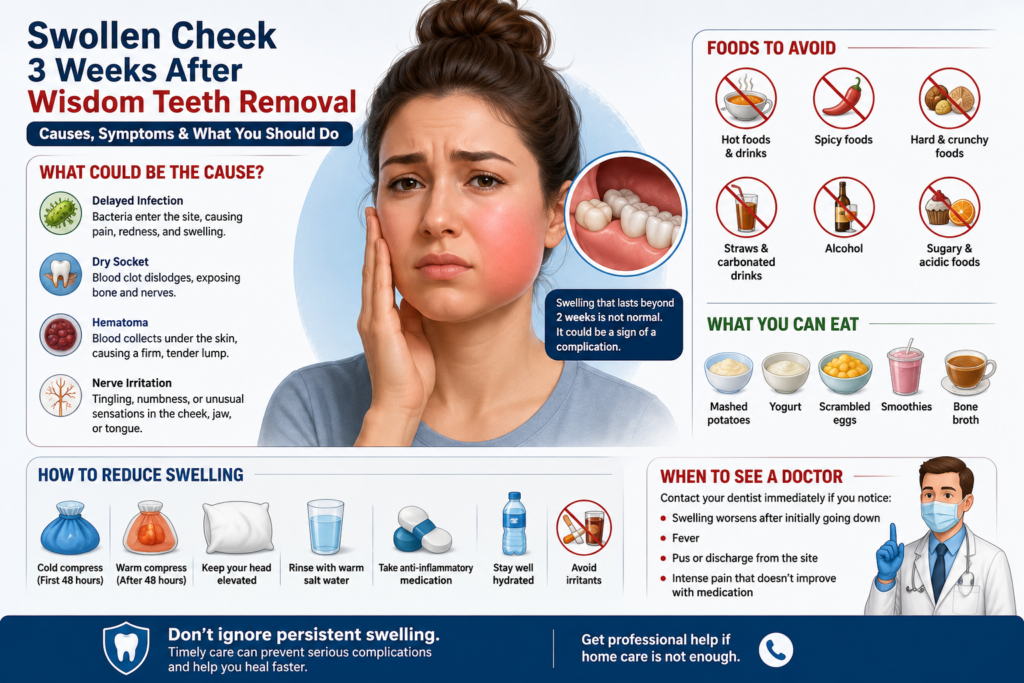
Delayed infection: Even if the surgical site was healing well at first, a secondary infection can develop if food particles get trapped or oral hygiene lapses. You may notice swelling returning after a period of improvement.
Dry socket: Dry socket occurs when the blood clot dislodges from the extraction site, leaving the bone exposed to air, bacteria, and food particles. It causes severe pain that begins 3 to 5 days after surgery and swelling persists because healing cannot progress.
Hematoma: Blood can collect under the skin, creating a firm and tender lump. It differs from normal swelling because it feels solid rather than soft and puffy, and it changes color as it heals, from purple to green to yellow.
Nerve irritation: It is very rare case, you may feel tingling, numbness or electric-shock-like sensations in your cheek, jaw, or tongue. It could be due to nerve irritation, and a prompt assessment by a dentist is essential.
Some other signs of infection include pain, firm swelling, redness of the soft tissue and warmth to the touch. Fever is another sign, but it comes late and occurs after other signs have already appeared.
Which Foods Should You Not Eat After Wisdom Tooth Removal Surgery?
Do you want to recover faster and avoid prolonging your swelling? Then you must pay close attention to your diet. What you eat plays a direct role in how well your body heals.
You should avoid the following foods after wisdom tooth removal:
Hot foods and drinks: Heat increases blood flow to your face, which worsens swelling. You should stick to room temperature or cold items for at least the first week.
Spicy foods: Spicy items irritate the tissues around the extraction site and can cause significant pain and inflammation. You should save the spice for when you are fully healed.
Hard and crunchy foods: Hard foods such as nuts, popcorn, or chips can irritate or injure the surgical site. You should avoid them for at least a week, if not longer.
Straws and carbonated beverages: The sucking motion from a straw creates negative pressure that can dislodge the protective blood clot from the extraction site, leading to a painful condition called dry socket.
Alcohol: Alcohol interferes with the healing process and interacts with pain medications. You should skip it completely during recovery.
Sugary and acidic foods: Sugary foods promote inflammation and feed bacteria at the extraction site. Acidic items like citrus can also irritate open wounds and slow the healing process.
So, what can you eat? Soft options like mashed potatoes, yogurt, scrambled eggs, smoothies, and bone broth are all excellent choices. Greek yogurt offers protein without the need for chewing, and eggs are soft when scrambled and high in protein. You should prioritize foods that are easy to eat and rich in nutrients.
How to Reduce Swelling After Wisdom Tooth Removal
You do not have to sit and wait for the swelling to go away on its own. There are some proven methods you can use to reduce the swelling. Here is what actually works.
Apply a cold compress in the first 48 hours: You should apply a cold compress to the cheek for the first 48 hours, using an ice pack wrapped in a cloth for 15 to 20 minutes at a time with breaks in between. Cold constricts blood vessels, which means less fluid accumulation at the site.
Switch to warm compresses after 48 hours: Once the initial swelling subsides, warm compresses can improve blood circulation, reduce stiffness and promote healing. You should apply them for 20 minutes, three times a day.
Keep your head elevated: You should keep your head elevated while resting, as it aids in reducing fluid retention and decreasing swelling. You can use two to three pillows at night.
Rinse with warm salt water: Rinsing the mouth with warm salt water promotes healing and may help alleviate residual swelling. You should do it at least two to three times daily like in the morning, in the afternoon and at night.
Take anti-inflammatory medication: You should take your anti-inflammatory medication immediately and not wait for pain to start. Ibuprofen prevents inflammation before it peaks and prevention beats treatment every time.
Stay well hydrated: Staying well-hydrated supports the body’s natural healing processes and can contribute to reducing swelling. You should aim to drink at least eight glasses of water daily.
Avoid irritants: You should avoid tobacco, alcohol, smoking, vaping, and Foods like nuts, popcorn, chips, crackers, citrus fruits, hot sauces and sodas as they prevent irritation and aid in swelling reduction.
Physical activity: Do not lie down completely flat. Especially in the first few days, keep your head raised with extra pillows to stop fluid from building up and making you swell.
When Should You See a Doctor?
Do you know when home care is not enough? It is important to know the signs that tell you it is time to visit a professional doctor. At that moment, you should contact your dentist right away if you notice these signs:
If swelling worsens after initially going down, if you develop a fever, if you notice pus or discharge from the extraction site or if you feel intense pain that does not respond to medication. In these situations you need to book an appointment immediately
You should not delay professional care if you are dealing with a swollen cheek three weeks after wisdom teeth removal. Persistent swelling may require antibiotics, a deep cleaning of the surgical site, or further examination. Timely intervention can prevent symptoms from getting worse and promote faster recovery.
Some conditions like osteomyelitis, which is a bone infection or submasseteric abscesses, require urgent attention and sometimes surgical intervention. It is a general rule to follow: if you are not sure about your problem, call your dentist. It is always better to get checked early than to let a complication worsen over time.
FAQ’s
Why am I swelling 3 weeks after wisdom teeth removal?
It is not normal to be swollen three weeks after having your wisdom teeth taken out. Usually, swelling increases within three days of surgery and goes away in about a week. If there is new or persistent swelling at this point, it’s likely a sign of a problem, such as a delayed-onset infection, food stuck in the teeth, an abscess, or sinus irritation if the top teeth were removed.
Can you get an infection 3 weeks after wisdom teeth removal?
Yes, you can get an illness three weeks after having your wisdom teeth removal. While most infections happen in the first week, some can happen later. These are called “late-onset” or delayed infections, and they usually occur when food particles or bacteria become trapped in a socket that is still healing.
How long do puffy cheeks last after wisdom teeth?
It’s common for swelling in the cheeks to be at its worst 48 to 72 hours after the procedure and then slowly subside after that. Most of the visible puffiness goes away in 5 to 7 days, but sometimes the firmness can last for up to two weeks.
Why is my face so swollen after wisdom teeth removal?
It’s normal and expected for your face to swell up after having your wisdom teeth removed. It happens because the damage to your gums and bones causes inflammation. send more blood and fluid to the area to protect it and start healing.

Other Articles

What Is CEREC Technology?