




If a jolt of pain from your morning coffee or a scoop of ice cream has sent you down a toothpaste aisle rabbit hole, you’ve heard 2 names in the market that everyone else does: Sensodyne & Colgate. They both make sensitive-teeth formulas, both show up in nearly every “best toothpaste for sensitive teeth” list, and both claim to fix the teeth problem — but they don’t get there the same way.
This is not a sponsored article for either brand. It’s a straight, ingredient-level comparison so you can figure out which one is perfect for your teeth, your budget, and how fast you need relief.
Quick answer: If you want the fastest possible relief and don’t mind a slightly different brushing feel, Sensodyne’s stannous fluoride formulas (like Rapid Relief) tend to work sooner. If you want an all-in-one toothpaste that handles sensitivity, cavities, tartar, and whitening with a more familiar Colgate mouthfeel, Colgate Sensitive Complete Protection is the stronger generalist. The full comparison below explains why.
Sensodyne vs Colgate: Quick Comparison Table
| Factor | Sensodyne | Colgate Sensitive |
| Main desensitizing ingredient | Potassium nitrate (most lines) or stannous fluoride (Rapid Relief, Repair & Protect) | Potassium nitrate 5% (across the sensitive line) |
| Fluoride type | Sodium fluoride or stannous fluoride, depending on formula | Sodium fluoride |
| How it relieves pain | Calms the nerve (potassium nitrate) or physically seals dentin tubules (stannous fluoride) | Calms the nerve via potassium nitrate; fluoride adds cavity/enamel support |
| Time to relief | Quick Relief takes as little as three days, while other brands take two weeks. | Builds over roughly 2 weeks with consistent use |
| Extra benefits | Gum care, whitening, enamel repair, tartar control — varies by product line | Tartar control, plaque reduction, whitening, breath freshening in one formula |
| Texture/foam | Lower foam, sometimes described as a “clinical” feel | Foamier, more like standard toothpaste |
| Price (US, ~4–6 oz tube) | Roughly $6–$10 | Roughly $5–$8 |
| ADA recognition | Multiple lines carry the ADA Seal of Acceptance | Multiple lines carry the ADA Seal of Acceptance |
What Actually Causes Tooth Sensitivity
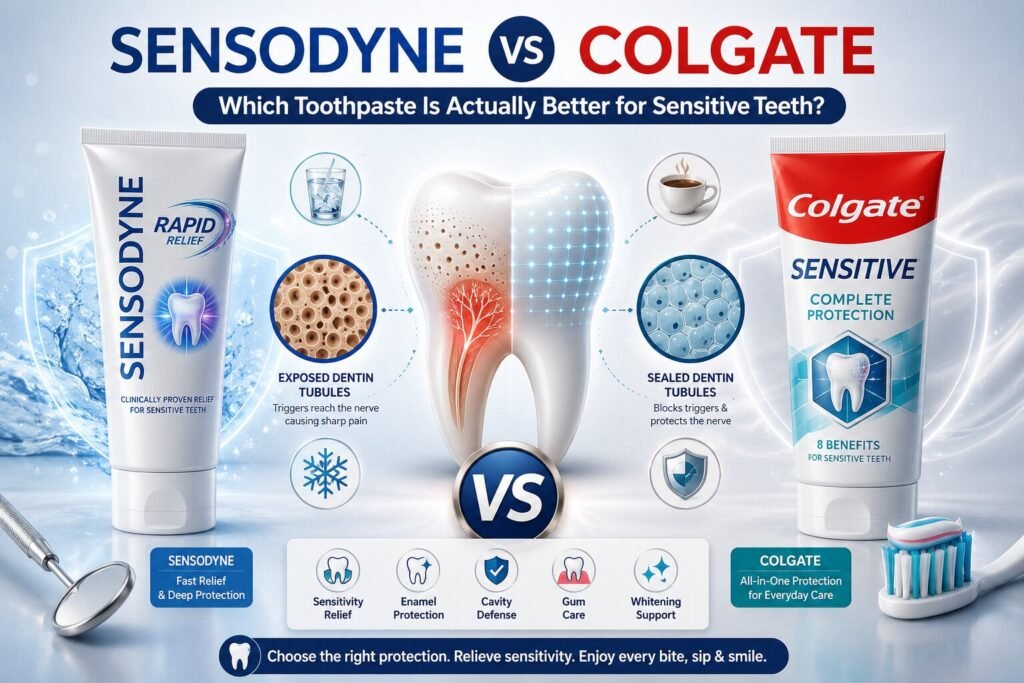
Before comparing the formulas, I will explain how they happen. Sensitivity happens when the enamel covering your teeth thins, from acid erosion, aggressive brushing or gum recession and exposes the dentin underneath. Dentin is riddled with microscopic tubules that lead straight to the nerve, so hot, cold, sweet or acidic triggers reach the nerve directly and cause that sharp, sudden pain.
Sensitive toothpastes work in one of two ways: they either calm the nerve so it stops overreacting, or they physically plug and seal those tubules so triggers can’t reach the nerve at all. That distinction is the entire reason Sensodyne and Colgate feel different to use.
Sensodyne Toothpaste: Ingredients & Product Lines
Sensodyne is a well-known toothpaste brand built almost entirely around sensitivity, so its lineup is broader and more specialized than Colgate’s. Depending on the product, you’ll find:
- Potassium nitrate (5%) — used in lines like Sensodyne Original and Pronamel; it soothes the nerve inside the tooth so it stops sending pain signals with regular use.
- Stannous fluoride — the active ingredient in Rapid Relief and Repair & Protect; it forms a physical, mineral-based barrier over exposed dentin, which is why these lines tend to work faster.
- NovaMin (calcium sodium phosphosilicate) — found in some Repair & Protect formulas; it’s designed to build a tooth-like mineral layer over sensitive spots.
Popular Sensodyne lines include:
- Sensodyne Rapid Relief – built for speed, with relief reported in as few as three days of twice-daily brushing.
- Sensodyne Pronamel – combines potassium nitrate and fluoride to protect enamel against acid wear. This is a perfect option if your sensitive teeth are caused by erosion rather than gum recession.
- Sensodyne Repair & Protect – aims to rebuild weakened areas of the tooth over time.
- Sensodyne Complete Protection / Sensitivity & Gum – Along with reducing sensitivity, it improves gum and plaque health.
- Sensodyne Clinical White / Extra Whitening – combines mild whitening agents with sensitivity relief for people who don’t want to give up brightness.
Most Sensodyne formulas skip sodium lauryl sulfate (SLS) in favor of gentler surfactants, which is part of why the foam and mouthfeel are noticeably different from a typical toothpaste.
Colgate Sensitive Toothpaste: Ingredients & Product Lines
Colgate’s sensitive line is smaller but more consolidated, most versions lean on the same core formula and layer additional benefits on top of it.
- Potassium nitrate (5%) is the active desensitizing ingredient across essentially the entire Colgate Sensitive range — it’s the maximum strength allowed by the FDA in an over-the-counter sensitive toothpaste.
- Sodium fluoride handles cavity protection and enamel support.
- Tetrapotassium pyrophosphate is added in some formulas for tartar control. Most Colgate Sensitive formulas do contain sodium lauryl sulfate, which is part of why they foam more and feel closer to a “regular” toothpaste.
Main Colgate Sensitive product lines:
- Colgate Sensitive Complete Protection – the flagship all-rounder, marketed for sensitivity, tartar, plaque, whitening, cavity and gum benefits in one tube.
- Colgate Sensitive Enamel Health – focused specifically on sensitivity relief with a simpler formula.
- Colgate Sensitive Plus Whitening – adds mild polishing agents for surface stain removal.
- Colgate Sensitive Prevent & Repair – aimed at enamel repair alongside sensitivity relief.
Colgate’s sensitive toothpastes are consistently built around potassium nitrate rather than stannous fluoride, so the mechanism is more uniform across the lineup than Sensodyne’s.
Sensodyne vs Colgate: Head-to-Head
Active Ingredients & Desensitizing Technology
Both brands lean on potassium nitrate as a baseline, so in their core “everyday” formulas, the chemistry is genuinely similar, both are nerve-calming rather than nerve-blocking. Where they diverge is Sensodyne’s use of stannous fluoride in select lines, which physically shields the dentin instead of just calming the nerve. That’s a meaningfully different mechanism, and it’s the main technical reason Sensodyne has more range in how it treats sensitivity.
Speed of Relief
This is where Sensodyne pulls ahead for people who want fast results. Sensodyne Rapid Relief and Repair & Protect are formulated with stannous fluoride specifically for quicker, more noticeable relief, often within a few days. Colgate’s potassium-nitrate-based approach typically needs about two weeks of consistent twice-daily brushing before you notice a real difference, which is standard for potassium nitrate formulas generally.
Cavity, Enamel & Gum Protection
Colgate Sensitive Complete Protection is explicitly built as a multi-benefit toothpaste, tartar control, plaque reduction, and whitening are bundled in alongside sensitivity relief, which makes it a reasonable single toothpaste for someone who doesn’t want to juggle multiple tubes. Sensodyne’s approach is more segmented: if you want gum-specific support, whitening, or enamel repair, you generally pick the Sensodyne line built for that particular concern rather than getting everything in one formula.
Taste, Texture & Daily Feel
Colgate’s sensitive formulas foam more and taste closer to a standard mint toothpaste, since most still contain SLS. Sensodyne’s formulas foam less and have a flavor profile some users describe as more clinical or medicinal, a trade-off for the gentler surfactant blend, which can matter if your gums are already irritated.
Price & Types
Sensodyne:
It depends on which specific tube size, retailer & formula you are choosing. Sensodyne toothpaste usually costs $5 to $15 per tube. On the lower end are basic cavity and whitening formulas. On the higher end are specialized formulas like Clinical White or Repair & Protect.
- Repair and Protect by Sensodyne (3.4 oz): ~on Amazon, it costs $6 to $10, on Walmart, it costs $7.47 for a single tube & on eBay, it costs $3 to $45+, depending on the size.
- Sensodyne Prevention for Cavities (2.7 oz): It costs $4.97 on Walmart, Sensodyne Sensitivity + Cavity toothpaste costs $6 to $8 on Amazon and $6 to $9 per tube on eBay.
- Clinical White by Sensodyne (3.4 oz): It costs $9.99 to $14.99 for each new tube on eBay, on Amazon, it costs between $20.80 to $24.47 & on $9.97 for a single tube on Walmart.
Colgate:
The price of Colgate toothpaste depends on the retailer, size, formula & variety. It usually cost around $1.50 to $10 each tube. Basic types that protect against cavities are cheaper, while more modern ones that whiten teeth or reduce sensitivity cost high.
- (3 to 4.5 oz ) Colgate Optic White: It costs around $5.96 to $14.99 on Walmart, $7.99 to $10.99 on Amazon, and $4 to $15 on eBay.
- The (5.1-oz) Colgate Total: It costs around $3.00 to $13.00 for each tube, it costs around $4.96 for a single tube and a pack of 2 usually costs $6.77 to $8.60, or a pack of 4 costs around $13.53 to $17.00
- Cavity Protection Colgate, 6 oz: It costs around $8.83 to $9.29 on Amazon, $13.50 and $27.00 each tube on eBay, and $1.97 on Walmart.
- (6.3-oz) Colgate Max Fresh: the cost of Colgate Max Fresh on eBay is $13.00 to $30.00, depending on the size, it costs around $3.96 on Walmart and $4.00 to $7.00 on Amazon. A pack of 3 or 4 costs around $9.00 to $16.00 on Amazon
What Dentists Actually Say
Dentist discussion threads and clinical guidance tend to agree on a few points that apply to both brands:
- Consistency matters more than brand. Neither Sensodyne nor Colgate works from a single use, most dentists recommend sticking with one sensitive toothpaste for at least 2 to 4 weeks before judging results, rather than switching every few days.
- If pain persists after four weeks of regular use with either brand, that’s a signal to visit a professional dentist rather than doing experimenting, persistent sensitivity can indicate a cavity, a cracked tooth, or gum recession that a toothpaste alone won’t fix.
- Both companies’ flagship sensitive lines carry the ADA Seal of Acceptance, so from a safety and efficacy standpoint, dentists generally consider either brand a legitimate first-line option, the choice comes down to your specific symptoms and preferences.

Other Articles