




What Is Front Tooth Crown Procedure?
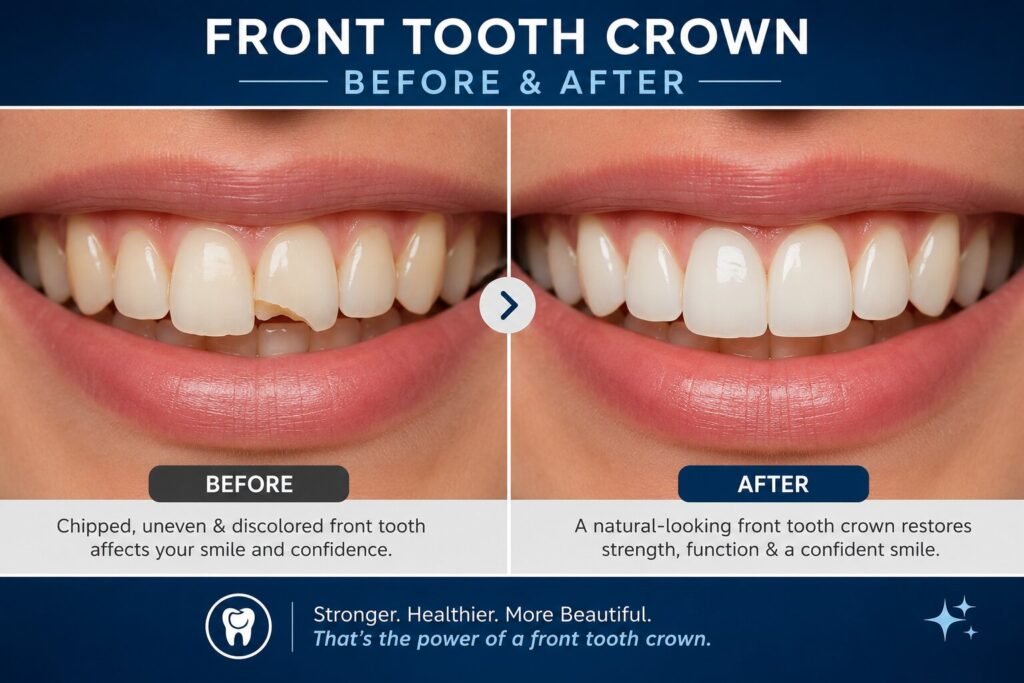
A front tooth dental crown is a tooth-shaped “cap” that is made just for you and covers the whole exposed surface of a broken or weak front tooth. It is usually made of very realistic materials like ceramic, porcelain, or zirconia and restores both structural function (biting) and appearance.
Dentists use a crown on a front tooth for teeth that are cracked, decayed, discolored, or worn from grinding. A crown on a front tooth structure works differently than a back-tooth crown, because when you smile or talk your front teeth show every time.
Common Reasons You Might Need a Crown on a Front Tooth
In some situations when dental crown may be needed for a front tooth crown. If you notice these signs:
- A large chip or crack that a filling can’t cover
- Severe discoloration that whitening can’t fix
- A tooth weakened after root canal treatment
- Extensive decay behind or around the tooth
- A tooth worn down from grinding
Not every damaged need a tooth crown. A tiny chip often responds to bonding instead.
Step-by-Step: Front Tooth Dental Crown Procedure
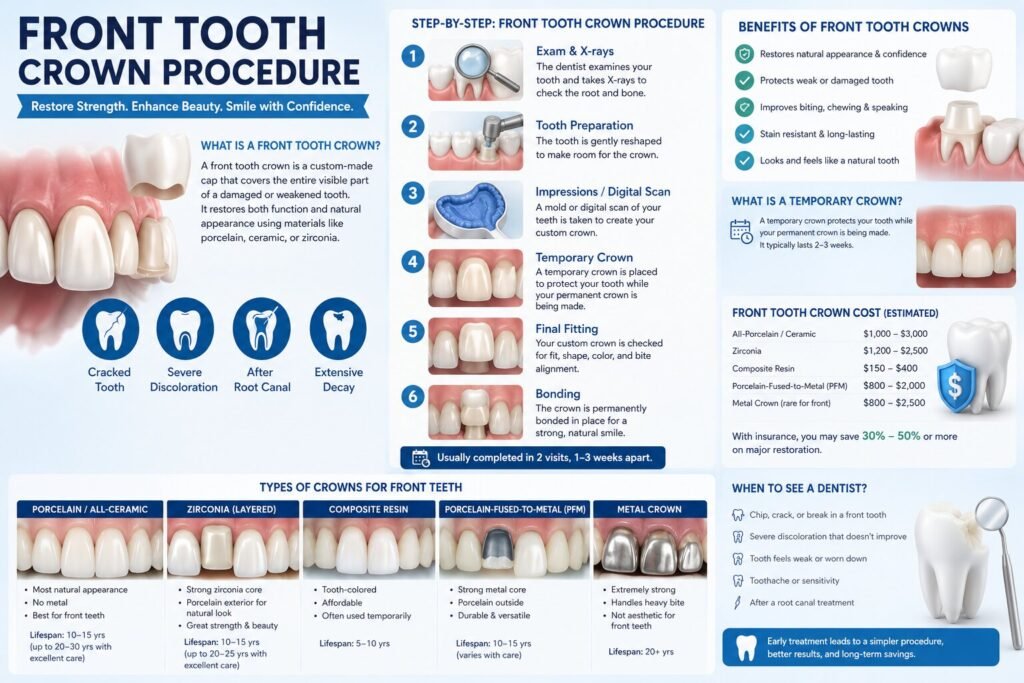
The front tooth dental crown procedure follows a predictable sequence. These are the major stages:
- Exam and consultation. The dentist checks the tooth and surrounding gum, often with a digital X-ray, and discusses material and shade options with you.
- Local anesthesia. A numbing injection keeps the prep comfortable, they didn’t pain during shaping.
- Tooth reshaping. The dentist files down the outer layer of the tooth, usually removing a small percentage of enamel, to create room for the crown to fit without looking bulky.
- Impression or digital scan. A mold or 3D scan captures the exact shape of the prepared tooth and bite, which gets sent to a dental lab to fabricate the crown.
- Temporary crown placement. A short-term acrylic crown protects the tooth and it looks normal while the permanent one is made, typically for 1 to 2 weeks.
- Final fitting and bonding. At your second visit, the dentist removes the temporary, checks the permanent crown for fit, shade, and bite alignment, then cements it in place and polishes it smooth.
Types of Crowns for Front Teeth
The best crown for your front teeth is one that is tooth-colored, fits your natural enamel, and looks like it lets light through. Some important choices are all-ceramic/porcelain for the most natural look, layered zirconia for high strength and good looks, and porcelain-fused-to-metal (PFM). You can read the Cleveland Clinic Dental Crowns Guide to compare.
Porcelain: These look the most like real teeth in terms of color, shade, and light transmission. They have no metals at all, which makes them excellent for those people who are allergic to metals, but they can be a little more fragile and break easily. It is highly durable than others. They can last 10 to 15 years, but with excellent care, they can last more than 20 to 30 years. Most dentists recommend this option first for visible teeth.
Zirconia crowns: Solid zirconia is very strong and durable, but it doesn’t look natural. To fix this issue, dentists use Ledged zirconia. It has a strong zirconia core and a layer of porcelain on the outside, making it very durable & beautiful. Zirconia crowns can last around 10 to 15 years, but with an excellent care, they can increase their lifespan to around 20 to 25 years.
Composite resin: These materials are mostly affordable options, because other metrticla cost high. They have a shorter lifespan rather than other dental fillings. They can last around 5 to 10 years. Often dentists use this for temporary restoration, they wait for a custom-made or permanent crown.
Metal crown: A metal dental crown is a strong & durable “cap” that is put on a damaged tooth to fix it. Dentists highly recommend it for the back teeth (back molars) because it can handle biting pressure & it lasts up to 20 years or more.
Porcelain-Fused-to-Metal (PFM): Porcelain-filled metal (PFM) crowns include a metal core for structural stability, it cover the outer layer of tooth- colored porcelain. Even though they are strong and can be used for many things, the metal base can sometimes show through as a dark line at the gum line. This makes them a little less ideal for people with very high smiles.
| Material | Appearance | Strength & Durability | Lifespan | Best For | Drawbacks |
| Porcelain / All-Ceramic | Most natural look; matches color, shade, and light transmission of real teeth; no metal | Durable, but slightly more fragile and prone to chipping | 10–15 years (up to 20–30 years with excellent care) | Visible front teeth; patients with metal allergies | Can break more easily than metal-based options |
| Zirconia (Layered) | Solid zirconia looks less natural; layered zirconia (porcelain over a zirconia core) looks natural and beautiful | Very strong core with added aesthetic layer | 10–15 years (up to 20–25 years with excellent care) | Front or back teeth needing both strength and a natural look | Solid zirconia alone isn’t ideal for visible teeth |
| Composite Resin | Tooth-colored but less refined than porcelain or zirconia | Lower durability than other options | 5–10 years | Temporary restorations while a permanent crown is made | Shortest lifespan; not usually a permanent solution |
| Metal | Not tooth-colored; visibly metallic | Extremely strong; handles heavy biting pressure | 20+ years | Back molars | Poor aesthetics; unsuitable for front teeth |
| Porcelain-Fused-to-Metal (PFM) | Tooth-colored porcelain outer layer over a metal core | Strong and versatile | Long-lasting, comparable to porcelain/zirconia | Teeth needing extra structural support | Metal base can show as a dark line at the gumline; less ideal for high smile lines |
Benefits
A front tooth crown offers more than a fresh appearance. It protects the remaining natural tooth from further cracking. It can restore your biting, cueing and power, so you don’t prefer one side of your mouth while eating. It can protect your teeth from fracturing. It also holds color well over time, unlike natural enamel, which can stain from coffee or wine.
If you use materials like Porcelain or Zirconia crowns that look like your natural enamel in terms of color and clarity. After this treatment, you can smile and speak comfortably anywhere.
A well-matched crown removes that hesitation or most people forget which tooth received treatment within a few weeks of wearing it.
What Is a Temporary Crown, and How Long Do You Wear One?
Short-term crowns are tooth-shaped caps that are put over a prepared tooth or implant while your final crown is being made. For the front tooth, this is important because they work as a placeholder so you can chew, speak and smile normally. But it can last 2 to 3 weaks unit your permanent or custom-made crown is added.
You should still avoid certain things and habits during this time:
- Skip sticky or hard foods
- Chew on the opposite side when possible
- Avoid biting into anything directly with the temporary tooth
- Brush gently around the area
Process of Getting a Front Tooth Crown
Getting a crown on your front tooth usually takes two visits to the dentist, spaced two to three weeks apart. The process includes numbing the area, consulting, filing the enamel down to fit the cap, wearing a temporary crown, using a custom match by making an image and the final restoration is the permanent option.
Your first visit centers on preparation. Your dentist removes a thin layer of enamel and reshapes the tooth into a smaller, even structure. This step decides how well the finished crown fits later.
An impression or digital scan follows. This model goes to a dental lab, where technicians match the crown’s shade, shape, and translucency to your surrounding teeth. You’ll wear a temporary crown during this waiting period, which usually lasts one to three weeks.
At your second visit, your dentist removes the temporary crown and checks the permanent one for fit, bite alignment, and appearance. Once everything looks right, the crown gets bonded permanently in place.
Is the Procedure Painful? What Does Recovery Look Like?
No, it’s not painful. Dentists use local anesthesia during the procedure, following ADA guidance on crown procedures. After the procedure, you can expect light soreness or temperature sensitivity for 2 to 3 days while the gums heal and the nerve settles down. This is normal and can be easily treated with over-the-counter painkillers.
You should expect this timeline:
- Day 1-2: Mild soreness, sensitivity to hot or cold
- Day 3-7: Sensitivity fades, temporary crown feels more natural
- After final placement: Any lingering sensitivity typically resolves within one to two weeks
If you notice sharp pain, call your dentist immediately, a crown feels loose, or a bite feels uneven after the swelling goes down.
How Much Does a Front Tooth Crown Cost?
Cost depends on your material choice, your location, and your dentist’s experience. The cost of the front tooth crown is around $800 to $3,500 per tooth without insurance. If you have insurance, then the cost is different they can cost around $500 to $900. Insurance can safe your money because it can save up to 50% of major restoration procedures.
- All-porcelain/ceramic crowns: $1,000 – $3,000 per tooth
- Zirconia crowns: cost around $1,200 to $2,500 per tooth without insurance
- Composite resin: Without insurance, composite resin for your front teeth usually costs $150 to $400 per tooth.
- Porcelain-Fused-to-Metal (PFM crowns): The average cost of porcelain-fused-to-metal (PFM) crowns is around $1,100 to $1,500, but the cost without insurance is around $800 to $2,000 per tooth.
- Metal crowns: Metal dental crowns cost around $800 to $2,500 each tooth without insurance (rarely used on front teeth)
When You Need a Professional Dentist?
You should visit a dentist instantly if a front tooth chips, cracks or changes color. Delaying treatment often turns a simple fix into a more complex one.
A professional dentist is very important:
- Uses the latest images and digital prints to plan treatments accurately
- Carefully checks alignment, teeth, bite, gum health and aesthetics before final placement
- They offer good laboratories for realistic crowns and restorations
- Takes time to explain your options, treatments and aftercare
- It’s not just about restoring your tooth, it’s about your confidence.
Book a consultation as soon as you notice damage, rather than waiting for pain to force the decision. Early treatment keeps your options open and keeps the final result looking natural.

Other Articles

MetLife Dental vs Delta Dental: 2026 Comparison Guide