



A crown or veneers both fix the entire tooth. But they also have different roles. A veneer covers only the front of the tooth to look great. On the other hand crown is used to cover the whole tooth, like for a cracked, decayed, or weak tooth. In this guide, I will explain the difference between front teeth crowns vs veneers, cost, timeline, and which one is good.
What Is the Real Difference Between a Veneer and a Crown?
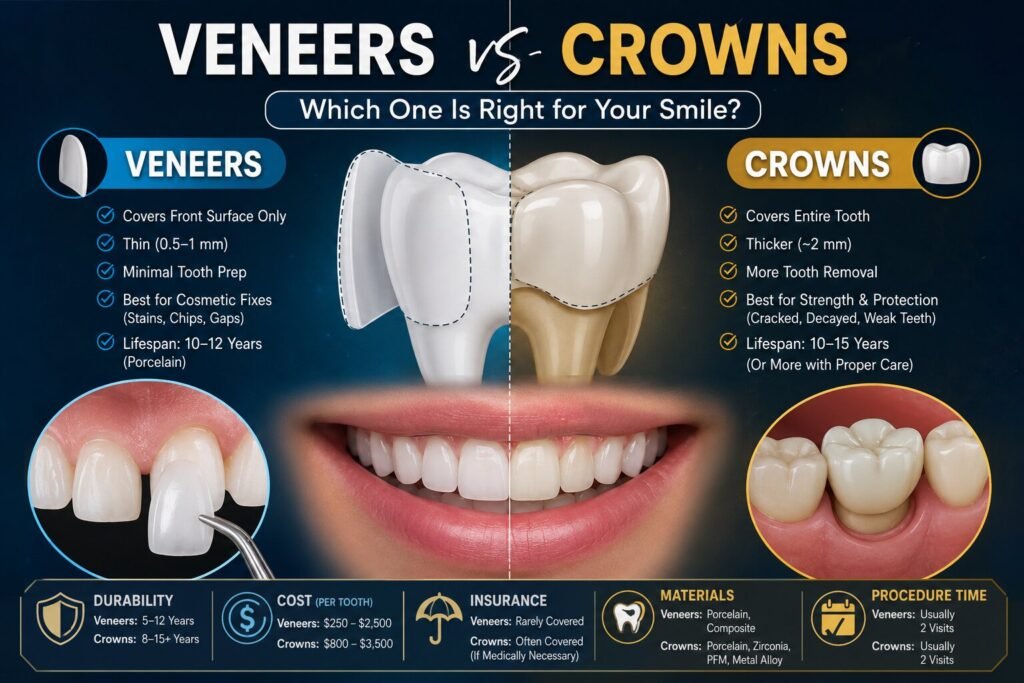
The difference between a crown and a veneer is just the number of teeth they both cover. The crown is a small cap. It fits over the whole tooth and covers up to 2mm thick. The veneer, on the other hand, is a thin shell that covers only front teeth, it’s about 0.5 to 1mm thick.
That thin layer still hides stains, chips, and small gaps well. Porcelain and composite resin remain the two most common veneer materials today. Both crowns and veneers get color-matched to your natural teeth, except for solid metal crowns.
How Much of Your Natural Tooth Does Each One Remove?
Tooth preparation marks the biggest gap between the two paths. A crown needs more enamel removed to wrap the entire tooth. Your dentist may numb the area first. A cut that deep can reach sensitive layers underneath.
A veneer needs far less enamel work, often just a light surface polish. Some newer veneer types need almost no adjustment at all. Less removal means more of your original tooth stays intact. Removed enamel never grows back for either option.
What Do Veneers and Crowns Look Like Side by Side?
A side-by-side view makes the choice easier to picture. Here is how the two options compare on the details that matter most.
| Feature | Veneer | Crown |
| Coverage | Front surface only | Entire tooth |
| Thickness | 0.5–1 mm | ~2 mm |
| Common materials | Porcelain, composite resin | Porcelain, metal alloy, PFM, zirconia |
| Tooth prep | Minimal | Significant |
| Typical cost | $900–$2,500 (porcelain); $250–$1,500 (composite) | $800–$3,000 |
| Typical lifespan | 10–12 years (porcelain); 5–7 years (composite) | 10–15 years |
| Reversible | No | No |
| Best for | Cosmetic fixes on a healthy tooth | Structural repair on a damaged tooth |
When Does a Dentist Recommend a Crown?
As I told you before, a dental crown is needed when a tooth is too much weak, decayed or broken for a normal filling to fix the tooth. In this situation include cracked teeth after root canals and large fillings. A crown rebuilds strength and restores your normal bite.
Sometimes dentists also use crowns to anchor a dental bridge in an area. A tooth with a very large filling can benefit from one too. Thin tooth walls tend to crack under pressure without that support. The tooth needs protection, not just a better look.
When Does a Dentist Recommend a Veneer?
Dentists recommend dental veneers for composite shells on the front teeth area or custom-made porcelain. This is mostly used to fix cosmetic flaws like broken teeth, small gaps, severe staining, and chipped teeth.
A veneer will not only fix a tooth with heavy decay or a cracked root. It also will not replace a tooth that needs a root canal first. Healthy structure underneath matters more than the surface problem on top. That single rule guides most veneer decisions in daily practice.
What Happens During Each Procedure?
A veneer procedure follows a short, predictable path.
- Your dentist trims a thin layer of enamel from the tooth surface.
- Your dentist takes a digital scan or a physical mold of the tooth.
- A lab crafts your custom veneer. You wear a temporary one until it’s ready.
- Your dentist bonds the finished veneer with dental cement and a curing light.
A crown procedure takes a bit longer. More work happens before the final piece goes in.
- Your dentist removes decay and reshapes the tooth for a secure fit.
- Your dentist takes an impression or scan for the dental lab.
- A temporary crown protects the tooth in the meantime. The lab builds your permanent crown next.
- Your dentist cements the permanent crown and checks your bite alignment.
How Long Does Each One Actually Last?
Crown lifespan claims vary across dental sources. That gap confuses a lot of patients. According to some sources, people said is can last between 8 years. But mostly people said it can last between 10 to 15 years with proper care. In short, dental crowns last between 8 to 15 years or sometimes they can endure 25 to 30 years with proper care. The real number depends on your bite force, your hygiene routine and the crown material itself.
Porcelain veneers usually last up to 10 to 15 years. Composite veneers wear out faster, often within 5 to 7 years. According to some clinical studies, the survival rate is 85% at 15 years or 95% at 10 years. With proper dental checkups or proper care, it can last 20+ years.
It you are doing night grinding, then it shortens the lifespan of both types.
What does a Crown vs Veneer cost in 2026?
Composite veneers run the most budget-friendly route, priced between $250 and $1,500 per tooth. Porcelain veneers cost a little bit more, typically $900 to $2,500 per tooth, but they last longer and resist stains better. Crowns sit at the higher end overall. Expect $800 to $3,000 per tooth, depending on the material and the location.
Does Dental Insurance Cover Either One?
Dental insurance rarely covers a veneer, it is mostly not covered. Most plans treat it as a cosmetic choice. On the other hand, a crown is covered by dental insurance, but only if the treatment is important, like a decayed tooth or a weak or cracked tooth. Crowns are major restorative care and it covers 50% of the whole cost.
Which Material Holds Up Best Over Time?
Material choice shapes both the look and the lifespan of your new tooth. Zirconia crowns bring serious strength and rank among the most durable options today. Lithium disilicate, sold under the name e.max, gives veneers a lifelike glow older porcelain could not match. Metal alloy still outlasts almost everything else, but most patients skip it for front teeth because of the color.
The dentist will weigh strength against appearance for your specific tooth. A back molar can handle a stronger, less translucent material. A front tooth usually calls for a material that mimics natural enamel closely.
What Risks Come With Each Choice?
Both procedures carry mild, short-term risks you should know upfront. Sensitivity to hot and cold food it can damage the root canal. Cracking under pressure and chipping often show up right after your appointment. That sensitivity usually fades within one to two weeks on its own. In rare cases, a deep cut near the nerve can lead to a root canal later. Neither option reverses once the dentist removes the enamel. That fact alone makes a second opinion worth your time before you commit to either path.

Other Articles
Does Donald Trump Wear Dentures?