



Honestly, not really. A dental deep cleaning shouldn’t hurt while it’s happening, because the dentist uses anesthesia in the gum. According to people’s reviews, the reviews are mixed, but on the other hand, some patients fell lillte perssure, vibration and the odd scraping sound, not pain. The soreness people talk about shows up after the numbing wears off, usually for a day or two and it’s mild enough that most people manage it with ibuprofen and a soft-food day.
What Is a Dental Deep Cleaning?
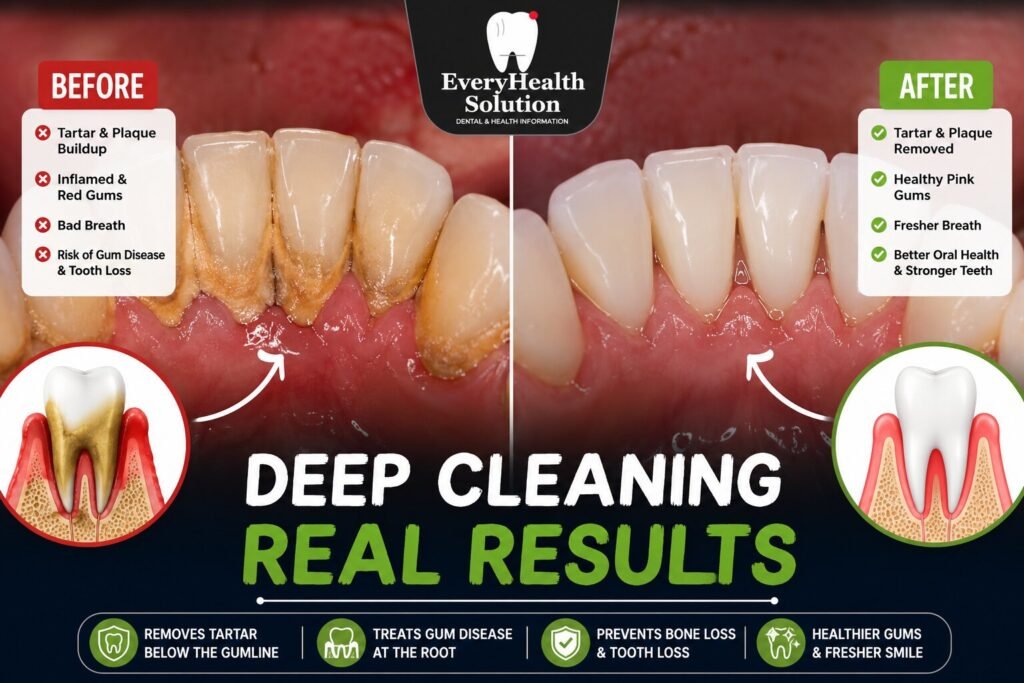
A deep cleaning, dentists call it scaling and root planing (special dental treatment), happens when plaque and tartar have built up below your gumline, not just on the visible part of your teeth. A regular cleaning only reaches what’s above the gum. Deep cleaning goes underneath it, into the pockets where gum disease actually lives.
Why You Need It
- Stop Damage: When you don’t brush regularly, it causes many problems, like preventing bone loss, painful cavities, poor breathing and ultimately tooth loss.
- Gum Infection: When plaque and tartar build up, it causes gum disease (periodontitis)
- Deep Spots: When gums pull away from the teeth and make holes 4 mm deep or more,
How It Works
- Scaling: Removing hardened plaque and tartar from the tooth surface and root, above and below the gumline.
- Root planing: Smoothing the root surface afterward so bacteria have a harder time reattaching, and so your gum tissue can heal and reattach to the tooth.
- Numbing: Numbing gel or local anesthesia is used during the process to keep you free from pain.
According to the American Dental Association, this treatment is specifically for gum disease that’s progressed past the point where a regular cleaning can fix it. If your dentist recommends it, don’t worry it’s because your gum pockets have already deepened past the healthy range, not because they’re upselling you.
Why Deep Cleaning Has a Scary Reputation (and Why It’s Outdated)
Scaling & root planing, a type of deep cleaning in dentistry, has a bad reputation because it targets hidden disease below the gum line, involves instruments working close to sensitive root surfaces, usually needs local anesthesia, and comes with warnings that if not done, bad things could happen like losing teeth.
What You’ll Actually Feel During the Procedure
It totally depends on the type of anesthesia used in the procedure. If a dentist uses general anesthesia, you won’t remember anything during the procedure, or you won’t feel anything. On the other hand, if you receive twilight sedation or local numbing, you feel minor touch, pressure, feel relaxed, or have no sharp pain.
General Anesthesia
- The beginning: An IV may sting for a short time, then make you feel warm and dizzy, and then you’ll fall asleep right away.
- During: You won’t remember anything and won’t feel any pain.
- At the end: You feel sleepy, groggy, or heavy, like you just woke up from a long deep nap.
Local Anesthesia
- The beginning: When the medicine is given, it feels like a small pinch or sting.
- During: The area goes numb; you may feel some dull pressure or pushing, but no pain.
- At the end: After a few hours, the tingling or numbness slowly goes away, and feeling comes back.
Twilight sedation
- The beginning: When you take medicine, you feel warm, heavy, and very peaceful.
- During: You feel like you’re in a dream and may hear noises, but you’re not worried or connected to anything.
- At the end: You don’t remember any single thing about the work.
What If You Skip the Anesthesia?
If you skip local anesthesia or numbing for a major dental treatment like a filling, root canal, or extraction, you will be in a lot of pain, your muscles will be tight, and your stress level will be too high for the dentist to do the work safely or at all. In some cases, patients ask if they can go without numbing, usually because they don’t love the feeling of a numb face for hours afterward.
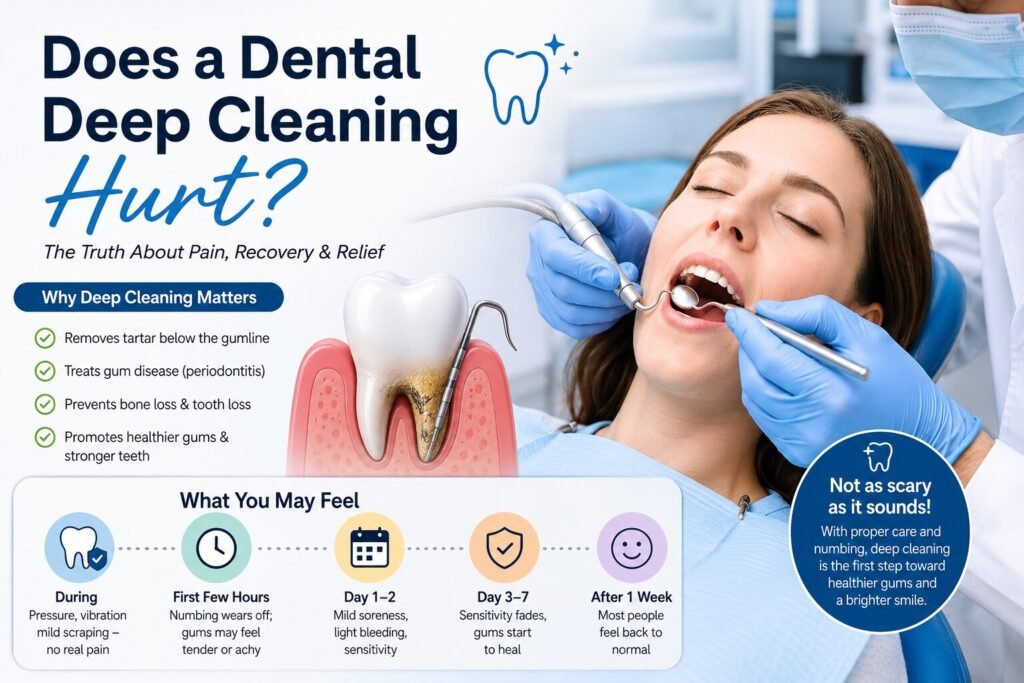
Pain Timeline: During vs. After vs. Days Later
| Stage | What you’ll feel |
| During the procedure | Pressure, vibration, mild scraping sensation — no real pain if numbed properly |
| First few hours after | Anesthetic wearing off; gums may feel tender or achy |
| Day 1–2 | Mild soreness, possible light bleeding, sensitivity to hot/cold |
| Day 3–7 | Sensitivity fading, gums settling into their healed shape |
| After 1 week | Most people feel back to normal |
How Long Does Soreness Last After a Deep Cleaning?
It usually takes 2 to 3 days for gums to feel better after a deep cleaning (scaling and root planing), and some teeth may be sensitive to hot, cold, or sweet foods for up to 1 to 2 weeks. Within 5 to 7 days, the gums usually start to heal and the pain goes down.
Recovery Time:
- First 24 to 48 hours: Mild aching, minor bleeding during brushing, and peak gum tenderness.
- Days 3 to 7: Less gum pain and growth that can be felt.
- Weeks 1 to 2: Temperature sensitivity will slowly go away as the gums heal and get tighter around the teeth.
Factors That Affect How Much It Hurts
Not everyone has the same experience, and a few things genuinely change how it feels:
- How advanced the gum disease is. Deeper pockets mean more tartar to remove and more inflamed tissue to work around.
- Your personal pain tolerance. This varies a lot, and it’s not something to feel embarrassed about.
- How well the anesthesia was applied. A rushed numbing job is the most common reason people report discomfort during treatment.
- Whether you’ve been keeping up with home care. Heavier plaque and tartar buildup generally means a longer, more intensive appointment. Bacteria trapped below the gumline is what drives the inflammation in the first place — understanding how that bacteria builds up can help you keep future cleanings shorter and easier.
How to Reduce Discomfort Before, During and After
Before:
- Brush and floss consistently in the days leading up to your appointment.
- Tell your dentist if you’re anxious, ask for a slower pace or numbing gel before the injection.
During:
- Speak up immediately if you feel sharp pain instead of pressure.
- Ask for a break if you need one, especially on longer appointments split by quadrant.
After:
- Use ibuprofen or acetaminophen for soreness (skip aspirin — it can increase bleeding).
- Rinse gently with warm salt water, a few times a day.
- Stick to soft foods for 24–48 hours: yogurt, eggs, soup, mashed potatoes.
- Brush gently with a soft-bristled brush, don’t skip brushing. You can brush 2 times a day
- If cold or hot sensitivity lingers, a desensitizing toothpaste can help; comparing Sensodyne and Colgate’s sensitivity formulas is worth a look if this becomes a recurring issue.
- Avoid smoking & alcohol for a few days, both slow healing.
When Pain After Deep Cleaning Isn’t Normal
Mild soreness and sensitivity are expected. These are not:
- Pain that gets worse after day 2–3 instead of better
- Fever, pus or a bad taste that won’t go away
- Swelling that spreads beyond the treated area
- Bleeding that doesn’t taper off after the first day or two
Any of these could point to infection, and it’s worth contacting your dentist rather than waiting it out. This is rare, the Cleveland Clinic notes that scaling and root planing is a well-established, low-risk procedure — but it’s still worth knowing what’s outside the normal range.
Common myths about Deep Cleaning
Many people think that deep cleaning is just cleaning for longer or that using more soap and strong smells will make the cleaning better. In reality, a deep clean does more than just make surfaces look shiny. It also cleans places that are hard to reach, like corners and behind appliances. Cleaning frequently and deep cleaning are the same thing.
Cost of deep cleaning teeth
A deep teeth cleaning, also known as root planing and scaling, usually costs between $150 to $450 for 8 teeth (per quadrant) in the US. A full-mouth (32 teeth) deep cleaning costs around $450 for basic cleaning or permanent cleaning costs $70,000 in the US for a full mouth. Without insurance, it is too expensive at that time for a full mouth cleaning it costs $200 to $600 (32 teeth) or for the per quadrant (8 teeth), it costs around $50 to $150.
The Bottom Line
A dental deep cleaning has a reputation it hasn’t earned in years. With proper anesthesia, the procedure itself is closer to uncomfortable pressure than actual pain, and the recovery is usually a day or two of mild soreness — not a week of misery. If you’ve been putting off a deep cleaning because of how it sounds, that fear is doing more damage than the treatment ever would; untreated gum disease is what actually leads to bone loss and lost teeth, according to the National Institute of Dental and Craniofacial Research. The cleaning itself is the easy part.

Other Articles
7 Worst Foods for Your Teeth (And What to Eat Instead)
Top 10 Dentists in New York: A Complete Guide for 2026